
 Apple Podcasts
 Amazon Music
 YouTube
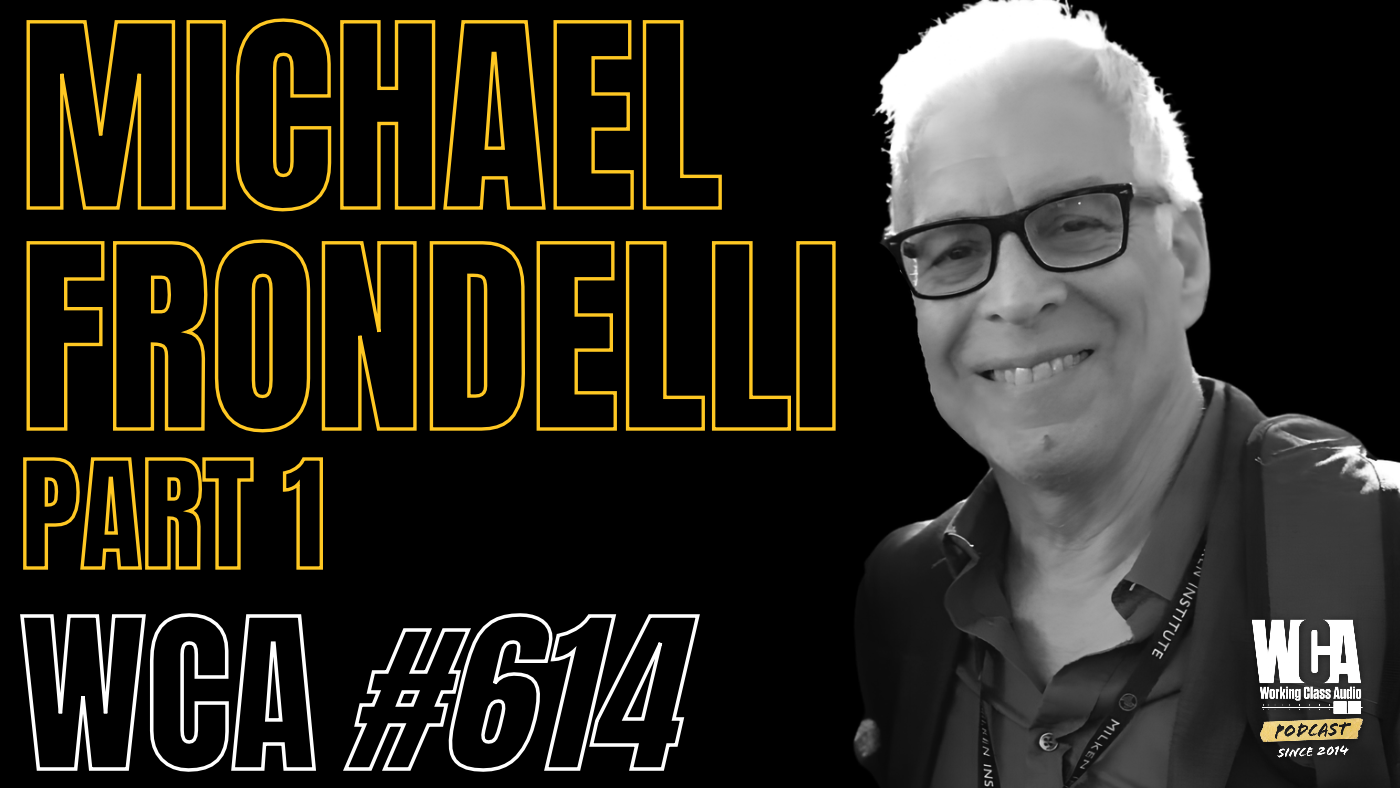
WCA #614 with Michael Frondelli, Part 1 – Astoria, R&B Days, Salsa Nights, and Electric Lady
For episode 614, Matt talks with Michael Frondelli, producer, engineer, and former Vice President of Capitol Records Studios, where he ran the facility for eleven years before going independent in 2001. Michael grew up in Astoria, Queens. Tony Bennett took vocal lessons with his Uncle Sal. The Walken family ran the bakery on Steinway Street. He came up playing guitar in soul bands and rock bands in the 60s, studied business in college, landed a maintenance tech job at Broadway Recording on 1697 Broadway, and from there made his way to Electric Lady in November 1975, where he spent nine years. This is Part 1 of a two-part conversation.
In This Episode, We Discuss:
- Growing Up in Astoria, Queens
- Music in the Family and Learning Guitar
- Soul Bands, Rock Bands, and the 60s
- College, the Draft Lottery, and Moving to Manhattan
- Carpentry, Soundproofing, and Finding a Way Into Recording
- Broadway Recording at 1697 Broadway
- Learning to Listen, Watch, and Visualize Signal Path
- Landing at Electric Lady in 1975
- Nine Years in the Room: Zeppelin, Chick Corea, Jaco Pastorius, Joni Mitchell
- Working With Eddie Kramer on Song Remains the Same
- Rebel Yell: Finding Billy Idol a Drummer
- Keith Forsey, Charlie Sexton, and Don’t You Forget About Me
- Getting Management and Learning the Business
- Going From $5 an Hour to $2,500 a Mix
Matt’s RANT!: Revisiting Backing Up and Archiving
Links and Show Notes:
Credits:
- Guest: Michael Frondelli
- Host/Engineer/Producer: Matt Boudreau
- WCA Theme Music: Cliff Truesdell
- The Voice: Chuck Smith
Watch on YouTube
Read the Full Transcript
Michael, welcome to the podcast. Thank you. Great to have you here. I got to give a shout out to our mutual friend Jerry stalker. Jerry has been a mentor and a friend to me for many years, and he’s the one that set this up. So I just want to give give thanks to Jerry because I really appreciate him.
I love Jerry Jerry’s fantastic musician and a great friend. Let’s start with the state of the state. Who are you? Where are you and what do you consider yourself? What I am is a producer engineer by profession. I’ve been a record executive, have had my own label, and I’ve worked for a major label as vice president, Capitol Records Studios for 11 years.
I’ve been independent since 2001 and have done various projects. I live in Studio City, California, and I’m always open for a new adventure. Where did you grow up? I grew up in a place called Astoria, Queens, made famous by Tony Bennett and Christopher Walken. Tony grew up with my family. My Uncle Sal, and he were very close, taking vocal lessons together, and he used to have dinner with my grandparents.
Chris Walken’s family had a bakery on Steinway Street in Astoria, Queens. My mother used to buy birthday cakes there. It’s a pretty interesting neighborhood. Working class, all working class. What was your early exposure to music? Was? Was it because of Tony Bennett? Were you in school band? Did the other kids in the neighborhood play music? All of the above.
What happened was that I grew up with music because my Sicilian family, my uncle, played mandolin and guitar, and my grandfather played guitar. So every Saturday there was these Italian gatherings with food, lots of food, fighting and music. I mean, it made a big impression on me. It wasn’t until I heard Elvis that everything changed. My first record that I made my parents by for me was Blue Suede Shoes by Elvis, not Carl Perkins.
I was smitten with it. I was I had to learn. My dad played guitar. I never saw him play guitar, but he had this old, old guitar. And I somehow reconstructed it. To somehow be able to play it would action that was like an inch off to fingerboard. I convince them that I had to take guitar lessons and that’s how I started.
Then I had a band. I had several bands, you know, the Royal garage bands. I had a soul band. I had a soul band in the middle of Queens with a black horn section and people from Performing Arts High School. There was a gentleman that I had met were still great friends, guy named Mark Duke, who lives up in Washington.
Fabulous keyboard player. He was studying at Performing Arts High School and Juilliard at the same time, and at the time, he can play the entire solo note for Note to Light My Fire. He could also play Take Five by Dave Brubeck, and I was studying guitar. I was I was studying chord melody. I had a guitar teacher who used to play with Julie London on the road, and he was teaching me chord melody.
My reading chops were terrible, but I could learn whatever he played. So chord melody was what I had started out with. And then I got into rock bands and we were playing psychedelic clubs in the 60s and school dances and whatever. Mark was the first hippie I ever met, and he was wearing beads, and my parents said, you know what’s wrong with them?
And but they got to love him. And we started just running around playing Fashion Institute of Technology in Manhattan. We play Rush’s at Fordham University in the Bronx. For me, it was, you know, I had a Ford 63 Ford Falcon. I would take out the back seat and put in my Fender Bandmaster in there and my Gretsch Tennessean at the time until I got my SG, and then we were all playing rock clubs, and we fashioned a band after the Jefferson Airplane.
We were big into the San Francisco scene, you know, our psychedelic days. And Mark was smitten with Jack Cassidy. That led to another part of my life working with Alembic out of San Francisco. How did you parents feel about your musical aspirations? Were they supportive? Mildly. I grew up with depression. Baby parents. For them, they saw the darker side of life, World War two, and they wanted something better for me.
I went to college, I studied business, they wanted me to go to school to be be an accountant or a lawyer. I had a choice to do both. I went for two years. I got an associate’s degree. I graduated two years in 1970, right after Kent State. Oh, right. And I was completely not happy about anything that was going on.
I had a two year student deferment from the draft, and I became eligible in 1970, and that would have been in July 1970. And there was a lottery, and I was in the second lottery and my number came up to high. So I was one of the fortunate ones because I had friends, even the ones who came back that were really messed up.
And it’s very similar to me to what happened. Post-World War two, when I read Keith Richards book, life and, you know, postwar UK, and he was in Dartford, Kent, and which was bombed out heavily during the war, also the same area where Vox amps came from. Interestingly enough. But, you know, it was that time where you could be drafted, like in England and somehow or another, we didn’t, I didn’t, and I was very grateful for that.
I wanted to say just about your parents, you know, I think because of, you know, the generation of your parents, you know, in comparison to, say, some of my guests that might be a little bit younger and their parents are younger, like rock and roll at that time, from my perspective, it seemed more dangerous than it is now.
Now it’s more corporatized in many ways. But back then, I could see the concern of your parents coming from where they came from their viewpoint and the San Francisco thing going on with, you know, musically, what was happening in the Vietnam War is a very different time. You know, it wasn’t until 64 on the on The Ed Sullivan Show when I saw The Beatles, that everything really changed because I lost my mind.
Yeah. You know, they they wanted me to be focused on academia, and that wasn’t working for me. I had jobs, I mean, I worked in offices and did all kinds of stuff. I did credit and collection for Perfume Company for, you know, as I was going to school. But they were very insecure about that. And when I left home at 19 and I moved into into Manhattan, into Chelsea, they weren’t happy about that.
But I moved in with my girlfriend and I was looking for adventure. I did all kinds of odd jobs, everything you could think of. And then one day I have a I had a good friend named Pete. Uncle Peter used to call him. We learned fingerstyle guitar together. He was studying at the fretted school of Folk Instruments down in Greenwich Village, and I went to the same teacher.
This guy, Jack Baker, excellent teacher, taught Chet Atkins stuff, and Reverend Gary Davis, Mance Lipscomb, big Bill Broonzy, all kinds of things like that. He was an excellent player. He still teaches. I think you and Pete was also a carpenter. And we were going I was working off the books and working for cash and doing carpentry, and then I was soundproofing rehearsal studios in Brooklyn.
I was living in Brooklyn. I had moved to Brooklyn to Park Slope, Brooklyn. I was living in this place called the chick lit mansion on Carroll Street in Eighth Avenue. This beautiful old building, chick lit like the chick lit gum. Like the gum. The family. Yeah. So he would say, come out. You know, you got a hammer. I’m going to teach you how to be a carpenter.
And that’s what I would do. And it was a guy named Michael Moskowitz who had Speakeasy Studios on Garfield Place near Fourth Avenue. And he said to me, you know, you work really hard. He said, I have a friend who works at a recording studio in Manhattan, and I’d like to introduce you to him. He said, would you be interested?
As I said, yeah, sure. So I meet this guy named Alan Karp, and he’s a maintenance tech at Broadway Recording Studios at 1697 Broadway. And it was an R&B studio, and at night they would do salsa from the South Bronx. So I met this guy and brilliant guy. He was supposed to be a diamond cutter. Instead, he got smitten with electronics and he became this tech and he was building this studio.
It was two rooms. One was 16 track with a Scully two head 16 track machine. I think it was the M100, if I’m not mistaken. And then they had a series 79 eight track in the other room, and they had a Neumann cutting lathe in the back with a mono ES 59 mono head. That’s how they there were no cassettes back then.
So people were taking lacquers out and in the daytime they would do Tony Orlando and Dawn with Hank Mattress and Dave Apple. Hank mattress was in the tokens and Dave Apple was a Philadelphia arranger and together they were producing. Tony Orlando knocked three times on the ceiling, all those records. And then at night, Irv Greenbaum. This guy was amazing.
Irv Greenbaum all these engineers were as old as my dad. They would be cutting these salsa bands full bands in the small room on the ninth floor, using the stairwell as an echo chamber, timbales, full horn sections, koto in the sound booth singing Ampeg baby bases, piano. Just phenomenal. I mean, just the whole thing. They come in with ice chest full of said Resa, you know, some beer.
Amarillo Pollo yellow, right. Chicken with yellow rice and beans and and they party all night. And there was a producer there who had a mound of white powder, and they would be working all night long. Irv was as straight as the day as long. And I would watch him work all hours of the night. He was military so he could copy Morse code.
He was really interesting guy. He was a radio guy. He was very patient and I used to watch him edit. We had Scully 282 tracks and he would edit on the Scully. He would never mark the tape because on on the edit all blocks you had Scully and Ampex spacing. There was a straight line and then there was a angle line.
The straight line was you would pull it off the head block, and it would match up to where the playback head was. So he would just put that down on the block, put it in, cut it and spin off the supply, reel all the tape until he was going to make his next edit point and cut them both at the same time.
And he was always on. How does one do that without the white grease pencil? He did it because the measurement on the edit all block was Scully spacing or Ampex spacing. So on the on the on the Scully spacing, he would take pull it off. He would pull it off this way, put it down on the block. And where the angle was is where it stayed.
So as long as you scrubbed the tape in the same place on the other side, you knew where you were going to be. So as long as you put it, you took it off the same way and put it on the block. He knew he would have a good cut. It always worked. It fascinated me and I. As a result, I want to learn how to tape at it, but nobody would teach me.
I was a night maintenance tech prior to that though. Had you had any exposure to a recording studio of that nature? No. What was your impression of the studio in it? In itself? Oh, I loved it. But the thing is, I had a work ethic and they loved me for that because I would show up on time or early and I would stay late.
And when I wasn’t busy, I was reading manuals and I was learning. I was teaching myself, and they wouldn’t answer questions for me. The engineers wouldn’t answer questions. And I’ll tell you why. What they would do with me is that they would say to me, what are you trying to accomplish? And I would say, yeah, but I want to get this microphone and I want to get it to go to this track.
And I wanted to do this. And they said, so, so how would you do that? What they were working with me was with a concept of signal path and how to imagine signal path and what I’m trying to accomplish and how to get there. So but, Tom, I understood the question I was asking. I would find the answer.
So it was all this visualization and it was torture because they were just really breaking my chops and not, you know, I say, but why just just tell me, show me how to do it. And I would get frustrated. But what a brilliant way to teach you by getting you to kind of talk your way through it and formulate how to do it, rather than just hand you the answer.
Life is very much like that for me, because if we’re always looking for the answer and we don’t understand the question, then we don’t know our goal. Skip ahead. Many years later, when I was interviewing engineers, both the Electric Lady and Capital, when you’re interviewing somebody, you want to find out whether or not they have a process, whether or not they can visualize, whether or not they’re worth the time to invest in, to teach.
Because I don’t care what school you go to, if you’re not working as an apprentice, with someone to really understand and someone to ask you to hard questions when it’s not going to cost you a whole lot when you’re not invested in it with a client, then how are you going to do that? And always you get these questions from artists and producers that, you know, I want to do this and I don’t know how to do it.
How do we do that? And then you have to invent the process. You have to come up with something. You have to come up with something unique. Finding people who are worth teaching as really was the goal for me at both places. And I wound up hiring some really good people. What were your takeaways from that? That studio, whether it’s how to handle people or technology or you know, how to conduct yourself?
I always had a professional attitude in working with people. I always came from a place where if I didn’t know, I would say I didn’t know, but I could find out. I wouldn’t blindside someone and say, I knew when I didn’t know. Mind you, I went into a lot of situations as an engineer where I would say yes to things and then figure it out.
The way I always thought about it was I could always find a wizard and I always did. I always surrounded myself with people who were much smarter than I was, and I could find out the answer and how to apply it to what I was doing. Where did you go from that position? Where did that take you next?
There was a mastering lab on the top of 1697 Broadway called Frankfurt Wayne. They they originated out of Philadelphia with Sigma Sound. Joe tarsiers place. And there was a guy named Tom Steele, and we met in an elevator one day, and he had known that the studio Broadway recording was in approaching financial problems. And he said to me, you know, there’s an opening at Electric Lady.
I know the studio manager and the director. Would you be interested in going for an interview? And I said, yeah, because I knew about Eddie Kramer, and I figured I had to learn from a master. It was important for me to know that I could learn from someone who had made hit records. And how would I do that?
I had learned enough to know what the next step could look like, and he set up an interview with Bruce Staple, who was the director of engineering at Electric Lady at the time. Electric lady was owned by the estate of Michael Jeffries, who was Jimi Hendrix manager. It was administered by an attorney named Maxwell Cohen, who was a divorce attorney, but he was administered the state of Michael Jeffries.
Jimmy had was already gone. I got to Electric Lady in 1975. In November of 1975. He was a very interesting guy. He was a very religious man, let me put it that way. When I met him, he was in a suit and tie. My understanding was that he had, at some point in his life, had been a psychedelic character.
Long hair, you know, fringe jackets. And now he’s in a suit and tie. So when I went for the interview three times, it took me to get the interview. He kept canceling on me. And finally I said, because I already started engineering, I was doing Latin sessions at Broadway recording. I was working with these Puerto Rican. It was Puerto Rican mountain music called gibberish, and they played the cuatro and the trees.
And, you know, it’s like almost like mariachi music in Mexico, but indigenous to Puerto Rico. And I was making I was recording already, so he was canceling on me. And I finally said, I said, listen, I would appreciate a notice if you’re going to cancel. I said, because I’m already working. I have sessions here and I’d be grateful for, you know, a reschedule.
So finally he did, and I came down. He interviewed me, and there were he was quoting scripture, but I had 12 years of parochial school, Catholic parochial school. So I was well armed. So I, we, we talked for a while and he was he was impressed. And he said he took me in the studio in a session he was working on.
And he the words of wisdom he gave me, he says he now Bruce Staple, was a great engineer. He had Allegro Studios in New York. He made all the Tommy James and the Chandler records. So he said to me, the one thing you want to learn how to do is put a unique sound on a record. And I said, putting a unique sound on a record.
So he says, yes, you want to do something that somebody hasn’t done before. I said, okay. He says, can you start tomorrow? I said, you know, I owe my employer notice. I said, I don’t think it would be fair for me not to do that. And but I can come down for orientation, if you like. And I could come after my shift and that’s what I did.
So that was November of 75, started nine years. And the first major session that I did. I worked with an engineer who’s staff engineer there named Bernie Kirsch. And by the way, when you worked with a staff engineer at Electric Lady, you got $5 an hour when you worked and when you didn’t work, you got $10. Oh. Excuse me.
You got $5 an hour when you worked. If you didn’t work, you would get a $50 draw. If you worked with an outside engineer, you got $10 an hour. So this is 1975. So I got to work with Bernie Kirsch. And Bernie had just finished working. He recorded horses for Patti Smith. We were going to work on an album called The Leprechaun, which Hickory?
And that was my first major record at Electric Lady as a second engineer. Can you talk about the differences between what you experienced at the first studio versus electric lighting? It was completely different for me. My role had changed. I went from a night maintenance tech to a second engineer. Did you sense not just equipment differences, but maybe differences in how the studio was run or how people approached it?
Did it have a different vibe? Totally. Broadway was more of a corporate vibe, but the woman who ran it, Fran White, was wonderful. And and they were very conscious about, you know, making expenses because the owner was always investing in new equipment and he didn’t care too much about money. And Fran was very focused on that. The equipment was very different, very similar with mix and things like that, and some outboard, but not as intense as Electric Lady was.
Electric lady was a rock studio. I mean, we were meeting Tony Orlando and Dawn Hall and Oates had come in Doctor Buzzard’s Original Savannah Band at Broadway recording. Tommy Mottola and his early days was bringing artists in and then the Latin Sessions. When I got to Electric Lady, it was completely different. It was rock n roll. I mean, there was there were pull texts, there were la two ways.
There were EMT 140 chambers, there was a data mix. There were two data mix consoles. The original one you see in all the Hendrix photos. I made lots of records on that one. It was a six bus console with a direct and a stereo bus. That was it. It had 40, I think 40 faders in the A console.
You had six busses, direct bus and a stereo bus. So if you wanted to have stereo drums with your toms and your symbols, you had to lift the stereo bus out to get the pan pot. And then everything else was either going to be direct or it was going to be bust out. Somehow you’re going to mix it together.
Broadway recording was the 16 track Sculley, the M100, and an eight track series, 79. In B at Electric Lady, there was a when I got there, it was a 24 track MCI and an MCI multi-track. Yeah. And then in studio B we had an Ampex 1016 track. Now studio A had a counter, a digital counter at that time on the MCI with a remote, and it would even stop on input.
You know, you can get input and here to mix.
After a playback. And then in studio B you had a switch. Dolby’s in order to be able to do that. And there was no tape counter. There was a thumb wheel counter. So I had to put grease pencil marks on on the, on the caps in, you know, on the tape from the capstone, just squiggly marks to know where I was to know how to jockey the deck and you had to know where you were.
Now, mind you, I’m doing this with Chick Corea and, you know, some serious time signatures and some serious tempos and night sprite on that alone is like from it’s crazy the tempo on that song. But you had you had to know you had to count bars. I had a follow score. I had to do all kinds of stuff.
So it was a lot different than where I was just a side tangent on the MCI machine. Once in a great while, they show up on reverb for sale. It’s just one of those tape machines that you just don’t see all that often. Electric lady was, you know, moving forward as fast as they possibly could. And that was that was a machine at that time in 75 that was pretty popular.
The electronics were a lot like an Ampex 440. In fact, the cards were very similar. We used to mix the Ampex for 40s. I always had to have a burnishing tool to be able to pull the cards out, to be able to a pink pearl eraser to clean the edge connectors if you started to hear things crap out on you.
But they were very similar to, you know, the MCI that had these, these drawers that pulled out with all the cards on them so you could do the alignment. So moving through Electric Lady, like, tell me about the the takeaways and the highlights of that of that time period. Because such a, such a significant, historically significant studio and so many, you know, amazing records to come out of there, it was a remarkable place to work in because you never knew who was coming in next.
You know, it could be Joni Mitchell with Charlie Mingus, it could be Larry Rosen and Dave Grusin with GRP records. It could be Creed Taylor doing jazz. We did lots of jazz. I mean, it was a center for where rock and jazz fusion had started. You know, whether it was Ray Gomez playing guitar or David Sanctions on keyboards or John Hammer, and then all these great New York City musicians and horn sections, and you never wanted to go home because you never knew what were you going to miss.
And in fact, before studio C was built at Electric Lady, that was Michael Jeffries apartment. I used to sleep there because if I’m doing a turnaround session and I only had like 4 or 5 hours, I would just crash there and rather than go home to Brooklyn, makes total sense. The client base, I mean, with Eddie, Eddie was always bringing in superstars.
So I worked on the film. Song Remains the Same with Eddie, with who was there that night, Jimmy John, Paul Jones and Bonham. Wow. They were in. Yeah, I worked with Ian Hunter, was Aynsley Dunbar, and then this new bass player, you might have heard of him, Jocko Pastorius, who was making a record with Bobby Colombe a bit, Camp Columbia at that time, which was portraits of Tracy and Jocko, was playing bass on all American alien boyfriend Hunter, so.
Well, yeah. And then you had the R&B cats. You had like Cornell Dupree, Steve Gadd and Dave Sanborn, Michael Brecker, Randy Brecker, Dave Taylor, Tom Malone, Ronnie Cuber, all these amazing musicians setting up to to, you know, to do R&B dates. We even did some jingle dates to I did start out doing Jingle Dates. You got your chops doing that because you got to move the sheer amount of superstars.
And, you know, maybe not every one of those is, you know, a household name, but I mean, Jocko, Steve Gadd, the Zeppelin guys, the kiss got like all of that combined. The immense amount of training and progress that you made as an engineer in that time period must have been immense. Yeah. You you had to learn how to multitask.
You had to learn procedure and process and record keeping. You know, now you have to do data management. Then it was different. You had to make sure that you knew what was on what track, where that tape box was. You know, where the tones were. And you better have good penmanship in those days. Penmanship. And you had to keep take sheets, you know, whether it’s a false start, a complete take, whether you did a playback on it, whether or not the artists liked it.
What were the comments at the time? What was the master? What was, you know, where the solo was? You know, whether it’s on a multitrack or you’re on a two track, you have to know the format and you had to learn how to edit all everything. You know, I had to learn how to edit multi-track. I had to learn how to cut at seven and a half, how to edit at 15.
IPS had edited 30 IPS. Eddie was, you know, we were doing Kiselyov two and I was running. I was running 3 or 4 delay tape machines for Eddie, and maybe four, 25ft loops out in the studio all at the same time to run audience, you know, banter and applause and everything else. Eddie, to mix live and at the same time reprocessing some overdubs that were done through the Altec 9845 playback speakers out in the studio with microphones just so you can make it sound like it was live.
Early ramping, early ramping, yeah. Also, I got to learn how to record guitars with Eddie. You know, how to how to get a room sound with Eddie, how to use microphones on a drum kit and be able to get them to sound like they were in a room. I also got to do the same thing with Mike Stone.
I don’t know if you know who Mike Stone is. I can’t think of who Mike Stone is. Worked at Trident, and he did a lot of those Queen records with Roy Thomas Baker. Right, right. Right, right. Okay, so I got to learn how to record drums. His perspective on recording drums and vocals and stuff like that with with Mike, you know, were you surviving like, like financially living in New York working or was it, was it kind of a little close to the edge?
Well, they say if you’re not living on the edge, you’re taking up too much room.
So I, I was smart enough with money in terms of my business background, my business degree, to know how to manage money very frugally. Until you really are in a situation where the money starts becoming exponential, you know, you’re not working for 5 or $10 an hour where, you know, I went to making 2500 to 3000 a mix that changed everything.
I got management and management triple my income, and in the first year the projects, the quality of the projects I was getting was so much better. And I was getting calls. When you go from, as you said, like, you know, the $510 an hour thing to large chunks of money when when a person gets large injections of cash like that, it’s amazing how that just kind of gets a person to relax just a little bit, because you’re not as you.
As we say, living on the edge smooths the edges out a little bit. Okay, I can pay the rent now for a few more months and everything’s cool. Yes and no. As an independent contractor, it’s very difficult because if you don’t have representation, you spend just as much time procuring projects then as you are working and you got to do both.
And when I had someone who was working with me, who would send me music to listen to and say, would you be interested in this? Would you be interested in that? I talked to this and R person, you can call him. You can get together with the artist and set up meets. It’s different. I don’t think you can as an independent contractor that you can get comfortable.
I think it’s always about having the next project unless you’ve got passive income, right? You know, unless you’ve got something where, you know, one guy who’s done it very well is Bob Clearmountain. Bob is excellent at it. He’s excellent at whatever he does, but he’s been very smart, as is Jimmy, Ivan, Jimmy, Ivan. When I knew Jimmy, he was Jimmy Shoes at the Record Plant.
And you know, he was always smart about moving up and finding the next artist to work with, whether it was Springsteen or Tom Petty or Stevie Nicks or whatever. And then ultimately, he made a lot of success with beats for yourself, the the introduction of management. How did that present itself? I was approached by a guy named James Fallon, and Jim is a good guy.
He was managing this guy named Daniel Lanois at the time, and who was working with Martha and the muffins at that time, Jim Scott and who else he have? Yogi Horton he had a drummer, Brian Foraker. He had a bunch of guys and oh, oh, John Mathias, another one from Record Plant. And so Jim called me and he says, you know, you want to meet.
And I said, yeah, sure. And he told me what he could do. And Jim wasn’t a man of many words, but he would set up meetings and then he would close the deal in five sentences, you know, and I started to learn about deal memos and, you know, how to set up producer, engineer royalties. You know how to read a contract.
I got an attorney. So you you learn the language of the business. It’s a lot more difficult now because there’s a lot of traffic in that lane, and you got a lot of people who are great on the box, you know, people who can work ITV and and do very well. But if you’re a songwriter, it’s even better.
If you’re a musician and you’re playing on the record, there’s another way to get royalties. You know, mailbox money is what it’s all about. If you know how to do that and how to relicensed what you have. But to get to be straight, straight engineer, working as an independent contractor is very, very hard. In fact, when you look at these universities that teach this stuff, it’s very low on the earnings scale for professions in these audio schools.
But audio means a lot of different things. Over the years I’ve learned how to do post-production. I’ve done a lot of I can’t tell you how many live shows I’ve recorded for television, for Mark Cuban. I’ve done it for. I mean, that all started when I did this movie, hail, hail, Rock n roll with Keith Richards. I want to back up a little bit on to Rebel Yell.
So were you still at Electric Lady when that was done? Yes, Dave Whitman had started it. Dave got called away on another project. The Billy and Steve were looking for a drummer. They hadn’t found a drummer to be able to finish the record. Keith Fauci, the producer who was a brilliant drummer on his own, who I actually recorded on Blue Highway.
I got out take somewhere of him playing Blue Highway. He had programed most of the album on a Lynne. He was a brilliant Lynne programmer. It was an LM two and he had, you know, he had his own samples or whatever, but he would make templates for Billy and Steve to write, and they could continue working without a drummer.
But there was no spark on the record for a lot of these tracks, and it required a live drummer. And Keith, as great as he is, he didn’t want to be the guy they needed. They needed their own guy, and he was wise enough to know that Patti Smith was recording with Mike Chapman and Bill Whitman and Studio eight, and my buddy Tommy Price was in there, and I had worked with Tommy on a bunch of records, including Ronnie Spector, and Tommy could play, and Tommy had a street attitude when he played right out of right out of Brooklyn, I.
So I grabbed Tommy. I said, Tommy, listen to looking for a drummer. We have been auditioning drummers. I said, can you come? Can you get away? He says, well, we’re not working weekends. He says, I can get away. I could get another kit, get my drum tech to set up another kit. I said, okay, let’s talk to Keith.
So we talked to Keith. Tommy came up, he listened to some tracks, and we had the kit set up in the room. And I said to Tommy, I said, you know, you got to play to a Linn. You got to play to a drum machine. And Keith was very, very conscious of how to work with a drummer. Being a drummer himself, he was brilliant at it, and he would have kicked snare and hat and he’d have the fills and all that stuff.
Then what he’d do, because what we would do is it was his all 24 track. We’d have timecode on 24, bumper track on 23, Linn Sync on 22, and a bumper track on 21. So I only had 20 tracks to work with, and a lot of times what we would do is we would run the Linn Sync and then print the Linn, but one he would work with live tremors so we could have tracks.
He would get rid of the printed kick snare hat, and then he write a percussion pattern, and the percussion pattern was locked with in sync with with the machine, with all the other overdubs are on it, and Tommy played to percussion pattern rather than play to a click. So he would have something to to to, you know, vibe with as opposed to to right.
You only hear a click if you’re not on it. Yeah, you’re either ahead or behind. And a lot of times you don’t know where. So a lot of guys, if they’re not pros at it, they’ll rush the fields and they won’t know where the next downbeat is. You know, they don’t know which which side of it they’re on.
But when you have a percussion pattern, you can swing within the pattern. And that’s the difference. That’s why that record sounds the way it does, because Tommy Tommy’s pocket Tommy wasn’t a head. He didn’t play a head or behind. He played on. He he was on. I saw it back then. And it was funny because I just did an interview about Eyes Without a Face.
Tommy didn’t play on it, but I’d love to see some of these transfers now, like Rebel Yell and Blue Highway with Tommy on it and see how close he was, you know, to the pocket. But he created his own pocket, and Tommy was just fierce that way, as he was with Joan Jett. You know, Tommy made a big difference.
Question about Keith Forsey. Did you and Keith work on Charlie Sexton? Yes. Pictures for pleasure. Beats so lonely. Yes. I can hear the single in my head. Yep, yep. In fact, we had auditioned, so. So I came out to California after Rebel Yell. Keith was working in the film business because he had he had worked on Flashdance and what a feeling he had co-written that was with Giorgio Moroder.
And he said to me, have you ever worked in film? And I said, not really. I said just soundtracks and things like that. He said, well, this is going to be score. And he had this song called Don’t You Forget About Me, and I have the original demo of Keith singing, and we’re talking about the Simple Minds song, Are We Not?
Yeah, Keith wrote it. I had no idea Keith wrote that. Yeah, Keith wrote that, And what happened was that Keith, the original idea was to have David Bowie do it and David Bowie, wow. Wasn’t going to do it. And then it went to Bryan Ferry and Bryan Ferry didn’t want to do it. And then it went to Charlie Sexton.
So there’s a version we did with Charlie Sexton with him singing Don’t You Forget About Me. We were searching and whatever. And then David Anderson was the film music supervisor from A&M. He said I got this band called Simple Minds. He says, we’ve been trying to break him forever and we can’t break him. So Keith flew over to London and he convinced Jim Kerr to do Don’t You Forget About Me.
And that’s how that happened. That’s unbelievable. That’s some insider baseball shit that I just did not know. I mean, to imagine David Bowie singing that. That would have been fascinating. When I heard Keith’s vocal, I had I had an old cassette I found and the cassette was it was pretty old and cassettes suffer from stitching and all that stuff.
But I got it to play. And when you hear Keith’s performance, it’s David Bowie. Don’t you forget about me. Yeah, he he was he was totally in that, in that world because Keith revered David Bowie. That would have been a very different thing, but still equally as cool. I love the song. To me, it it’s it’s such a iconic song.
All right. Michael, well, let’s let’s take a pause here because we’re going to split this into two episodes and we’re going to continue on the second half of the journey. So thanks for making time for me on this half, and I’ll see you on the second half. See you on the second half. Thanks, Michael.