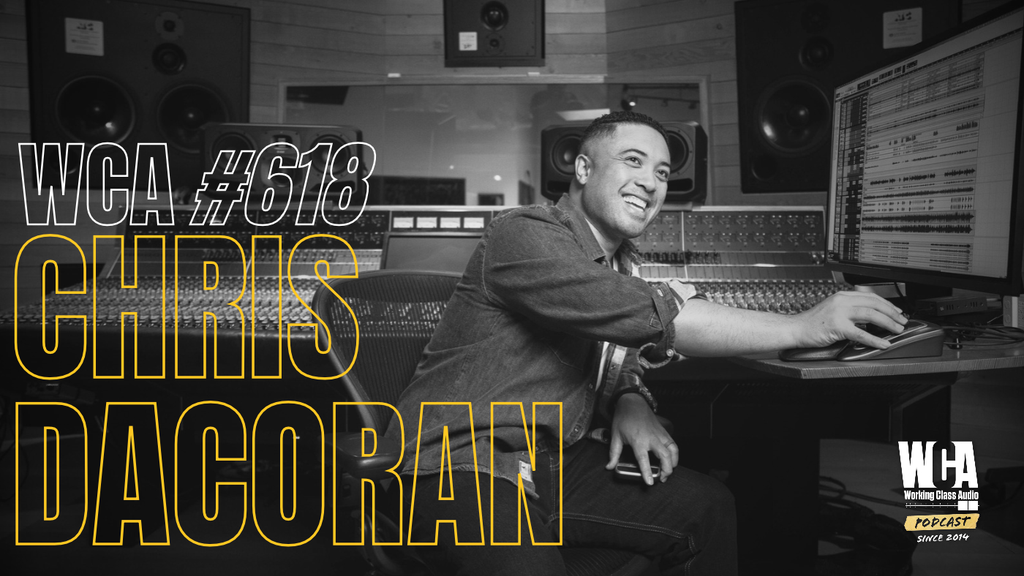
WCA #618 with Chris Dacoron
 Apple Podcasts
 Amazon Music
 YouTube
WCA #618 with Chris Dacoron: From Boy Band Singer to R&B Mix Engineer, the Artist Vision Form, and DMing Artists the Right Way
For episode 618, Matt talks with Chris Dacoron, a Bay Area mixing engineer working mainly in R&B, pop, and hip hop. Chris runs his mix business, Skye Heart Sound, out of his home studio in Martinez, California, and has been at it for over 20 years. The two met at a Bay Area Audio Nerds gathering. Chris started out as a singer in an R&B boy band that moved to Los Angeles in 2004, became an accidental studio assistant along the way, and switched to engineering full time when the group broke up in 2006. They talk about learning by level-matching his mixes against finished records, the Auto-Tune idea he shot down years before T-Pain, the artist vision form that cut his revisions to one or two, going hybrid after one hardware EQ changed his mind, saving rough iPhone vocals, why networking in person still matters, and how to DM artists without sounding like a car salesman.
In This Episode, We Discuss:
- Growing Up in the Bay Area Singing Along to Boyz II Men
- Forming an R&B Boy Band and Moving to Los Angeles in 2004
- Winning a Talent Competition and Becoming a Studio Assistant Nobody Was Looking For
- The Group Breaks Up in 2006 and the Clean Cut to Engineering
- Coming Home to the Bay Area and Building a Freelance Career Through Word of Mouth
- Setting Rates in the Middle Based on What Outside Engineers Charged
- Learning From Claudio Cueni, Tony Shepperd, and Ken Lewis
- Level-Matching Mixes Against Finished Records to Learn What a Final Sound Is
- Always a Student: R&B Sounds Change Every Five Years
- The Auto-Tune Idea Chris Shot Down Before T-Pain Made It a Hit
- The Artist Vision Form: Understanding the Artist Before Moving a Fader
- Handling Revisions as a Collaboration Instead of a Critique
- Going Hybrid After One Hardware EQ Changed Everything
- Making iPhone Vocals Sound Like a Real Studio: Silver Bullet, Saturation, and Expansion
- Matt’s Tip: Cleaning Up Rough Vocals With Adobe Podcast
- Money: Balancing Gear Spending With Marketing Yourself
- Try Everything: Networking Events, SoundBetter, Websites, and DMs
- Get Out of Your Herman Miller Chair and Meet People in Person
- How to DM Artists: Do the Work, Make It Personal, Don’t Sell Right Away
- Why AI-Written Pitches Are Easy to Spot
Matt’s RANT!: Stop Asking for Permission
Links and Show Notes:
Credits:
- Guest: Chris Dacoron
- Host/Engineer/Producer: Matt Boudreau
- WCA Theme Music: Cliff Truesdell
- The Voice: Chuck Smith
Video Interview
Episode Transcript (click to expand)
Chris, welcome to the podcast. Yes. Thank you for having me. It was great to meet you. The other night we for the audience, Chris and I met at the Bay Area Audio Nerds gathering that we do. Chris was a new face after chatting with him a bit.
I just thought he’d be great on the podcast. So here we are. I’ll just jump right in. Give us the state of the state. Who are you? Where are you and what do you consider yourself? Yeah. So my name is Chris Dacoron, a mixing engineer based in San Francisco Bay area. I run Skye Heart Sound, which is my mixed business, and I’ve been.
I’m a I’m a staff mixing engineer with Blue Two Records here in Martinez. Been doing this for, I guess over 20 years. And I primarily work in the R&B and pop genres. As far as your upbringing. Talk to me about where you grew up and what the influence of music was on your upbringing. Yeah, so I grew up in the city, the Bay area, and I say, I think my roots in music have always stemmed from from singing, right?
Like I would say, the artist that I really connected with when I was young was Boyz II Men. So because of that, I was an R&B singer first before I even thought about engineering. And also my parents also sang and did a choir when they’re younger too. So I think that all played a part in my musical upbringing in a sense.
Was there any influence of technology growing up later on? I mean, my parents never really were too tech savvy like that, but it wasn’t until later on when I met my group members before, and then we started wanting to do recording. And then from there, I think at some point, like, oh, you know what? Because back then we’d, we recorded in studios to, you know, to record.
Right. And they thought, okay, what if I just get my own equipment, you know. So that’s where I started out. I got like, you know, the computer, I got the preamp and the mic. And that’s how we started. But yeah, it wasn’t until later on maybe in like my maybe like 17 or 18 where I really got into the tech part of things when it comes to audio production, when did you start to pay attention to how records sounded and started to look at like, well, how how does this even work?
How does music come together on an album? Yeah. So when we when we recorded our first song, I think that’s when I started really getting interested because I noticed right away that, okay, our music doesn’t sound like the ones on the radio, you know what I mean? So I’m like, okay, wait. Hold on. I thought it was you just record and you’re done, right?
But then ever since we had our first recording with a professional studio and a professional engineer, it just didn’t sound the same. So from there, I’m thinking, okay, if I can hear these things and not the engineer, then I think I want to. I think I could get into this. So I think that’s when the whole audio production thing started in my mind when we finished our first song.
So tell me about your you’re mentioning your group. So talk to me about, you know, forming a group and what that entailed for you. Because you were you were a singer, right? Yes, yes. We’re four other singers. Yeah. Okay. Was it kind of like a boy band kind of thing? It was. It was kind of like a boy band.
It was during the boy band era. So we listened to a lot of Boyz II Men. And yes, you know, we did listen to a lot of N’Sync and Backstreet Boys. So that background was around that, that era. Okay. So in your mind at that time, your focus was to be, you know, a superstar of some type. Exactly.
That was that was my goal. It was never to be an engineer. It was to be a pop star. R&B pop star. Yeah. When you discovered the audio thing, I mean, obviously there was a goal there of trying to make things sound better for yourself. But was there also a new fascination with audio? For sure, for sure. I mean, I think once I got my my first DAW, which is Pro Tools, I think that’s when I really started to experiment with sound and EQ and compression.
And I think that even though when I started doing that at that time, it was never to become an engineer, it was it was still to be the best artist that we could be. But yeah, I would say it was during that time when it started really blossoming for many, including myself, who started out, you know, wanting to be, you know, a rock star of some type.
When you discover the audio thing, something happens, I think, in the brain where we start to realize, oh, shit. I’ve been on this track to do this other thing, and now I have this new distraction, and this new distraction is really pulling my attention away from what I initially set out to be. So was there any kind of immediate shift or identity crisis of like, oh, I think I want to do this full time.
Okay. So I think I got lucky there. So the group ended up breaking up. Right. So we so a little backstory. So we moved to LA in 2004. Right. So we moved there together to try to make it in LA. Right. So 2004 we we won this talent competition and we were supposed to get two free demos, two free song demos.
But for whatever happened, they they told us they couldn’t do it, but they’ll allow us the studio time. So I started working in the studio, as you know, to work on our music. And the owner noticed, oh, wow, the you know, Chris knows how to work the studio. So I ended up becoming like an intern of sense, like an assistant, and they weren’t even looking for one.
I just ended up becoming one. I started recording their artists and stuff like that. So? So anyway, so fast forward 2006 came, the group broke up and it had nothing to do with what I was doing. It broke up. It was more like an implosion, right? So will not get into that. But everyone went their separate ways, right?
So I had to decide at that moment. Okay. Do I want to stay in LA and work for little to nothing for the studio, or am I going to go home to reevaluate my life and move back with my parents? Looking in hindsight now, I wish I stayed there. I think I could have progressed my career much faster, but I end up going back home.
But the way that shift happened, it happened after the group broke up. So that’s that’s when I was like, okay, I’m going to go home. I’m going to reevaluate my career. I need to get a second income, but I’m going to start freelancing. So that’s when the switch happened. That was nice because you had a clean cut. It was a clean cut.
Yeah. So I’m just curious why you didn’t think of starting another band. Or maybe you did. Did you think about starting another group? No, no, I was done. I think what had happened was I was so burnt out with the whole singing, singing group because as a singer, there’s there’s more to it than just singing, right? There’s practice, there’s rehearsals, there’s what are you going to wear on stage?
You know, I mean, there’s also how are you going to look, you know, it’s it’s, you know, being a singer, you know, back at that time. You have to, you know, the goal was not to just be good singers, but also to look good on stage. Right. So I didn’t want to do any of that anymore. I just want to I love being able to freelance.
I just come to my space and work on stuff, and for me, it just I felt, I don’t know, I just had a better satisfaction for me. I didn’t want to go back to singing. So that’s. Yeah. And in some ways you almost have to be like an athlete too, because obviously, you know, you gotta you gotta work out all the time.
You got good, you got to rehearse. You got to be in shape to to move and sing. Yeah. You know, assuming that there’s not too much in the way of backing tracks. I don’t know if backing tracks were a big thing for you at that time. Yeah, it’s it’s a chore. It’s a slog. Yeah, yeah. So in coming back to the Bay area, what were some of your early moves to get established as an audio professional?
Okay, so I started freelancing, so I reached out to my old contacts and I started that way. Right. So word of mouth talked to people I know, and there was some success in that, but it was never really like sustaining. Also I try to do I don’t know, Fiverr was there at the time, but I try to get into those like platforms, but it was just really oversaturated.
So it was mainly word of mouth and mind you, at this time I was much younger so I didn’t know how to pitch myself right. You got this kid still in his early 20s, still trying to figure it out. It was tough in the beginning, but I was lucky because one of my group mates, he ended up becoming a music producer.
So this guy, he he, he was really good at songwriting and the music production part, but he didn’t know how to record and mix. So that’s where he brought me in. My friend, his name is Carlo. He was really good at communicating with people like he was a really good talker, really good at building rapport. So he spoke to the artist.
And then since I’m the engineer working with him, he just kind of just said, me, you know what I mean? Fed me project. And it was like that for a good number of years. So I would say I was lucky in that sense because my network and people that I’ve worked with in the past, he fed me projects, and that’s how I would say I really got a solid handle on becoming an engineer and pushing my career forward in a sense.
What about setting your rates in those early days? How were you? Did you struggle with like, what am I supposed to charge? The good thing is, like we’ve in our previous the previous songs we worked on when we were a group, we did work with outside engineers. So I kind of based what I should charge on that information.
Right? So I was like, okay, I can’t charge top tier. I know I’m not a beginner. I could probably fit myself in the middle. Right. And so I guess in a sense, maybe I felt lucky that I guess the amount I charge really never scared everyone off. Everyone felt like, okay, that was fair. Maybe I could have charged more, I don’t know, but, you know, it’s I felt like I found a fair rate at that time.
I mean, I looked online as well too, but I don’t think that information was fully out there at that time. So yeah, I just relied on the information from my past working relationships. So, you know, obviously you had exposure to audio production, you know, with boy bands and, and R&B and just the music that you ultimately would end up working in.
But who were your influences on how you would work or the sounds you were chasing? When I interned at the studio in LA, right next door was another studio and it was ran by Claudio Cueni. So Claudio, he worked on Tupac’s music. He also worked on Boyz II Men and other music in that era, so I’m lucky. Luckily enough, the owner of the studio that I was interning at, they were best friends.
So while he was working, while Claudio was working on our music, because he ended up mixing our music while he was working on it, I would, since he was next door, I would every now and then peak in and be like, oh, how are you doing? And try to get some information from him, you know, but just I think I would say learning from Claudio in the very beginning kind of shaped how I should listen to things.
But not only him, it was there was other engineers we worked with. I think it was Tony Shepperd. I just loved the way he mixed our stuff back then. So I would say a combination of Claudio and Tony Shepperd. Oh, I’m sorry, and Ken Lewis, Ken Lewis as well. Ken Lewis also worked on our early stuff. So I would say I think those three were probably the ones I would say kind of formulated how we should listen to things and my overall sound.
But yeah, there were other influences from artists as well, or like final, final mixes and masters from other artists that kind of built up on how I should listen to things as well, you know, like recognizing what you think sounds good versus getting those results is always a challenge because it’s like, you know, it’s like in a meal.
It’s like, well, you know how the soup should taste, but you don’t quite 100% know what, you know, ingredients went into that. So what was your method for, you know, understanding how to put those sounds, how to achieve those sounds that you were hearing from others. A lot of it was just referencing and experimentation. Like I would have, you know, final mastered music in the session.
And I would listen back and forth with my mix and their mix level matched. And this is before they had those AB plugins back then. So I did that a lot. And then it made me realize quickly how bad I’m recording, but also how raw things could sound. And for me thinking, oh, that’s a good sound. It’s like, no, that’s not a good sound.
This you have to put up. You literally have to put up the music in your session and hear it with your speakers. So that’s how we’re able to learn about, like how a final sound should be. But also it had I just had to experiment a lot with like saturation, distortion and all that kind of stuff. And eventually I got there.
But even then, even then, I’m still I’m still a student of the game, you know, I’m still learning things, how to do things. And, you know, I just feel like you’re still constantly learning like, and but I feel like I got the core foundation from experimenting in the beginning, but now it’s it’s more maintenance but still continue to learn.
And now with internet nowadays it’s everything is out there. You know, you could find a lot there in the internet, but it’s just so clumped, cluttered together. But the information is out there now, and I wish it was there back then so I could experiment less and no right away. But yeah, back then it was a lot of experimentation, trying things out and, you know, keep going until you get it.
So yeah, I mean, even now, you know, after 30 years of doing it for myself, like I still hear things and I just think, oh, there’s so much like further to go in terms of, you know, sometimes I think when you mentioned things sounding raw and thinking, it sounds good, it’s like many times I think artists are willing to accept early on they’ll hear something and think, oh, okay.
Yeah, it’s a recording of my voice or recording of my drums or guitar. And it sounds, you know, natural. That’s perfectly acceptable to me. It’s so like if you’re going to compete on a on a top tier level, you have to push things and squish and EQ things and shift things about in such a way to really compete in the air you’re in.
Yeah for sure. So I’d love to hear that. You know, it doesn’t matter how long you’ve been at it, you’re always a student. Hopefully. And hopefully you think you’re always a student. Yeah. I mean, I feel like sound has changed like over the years, right? I’m, you know, like how R&B sounded back in the early 2000 to now.
It has changed so much. So I feel like we’re always going to be students of the game because music always changes, tones always changes. So like, okay, if I want to still be relevant in this industry, I need to know what the new sounds are, right? So you constantly learn. Once you feel like you mastered it, a new thing comes along, right?
So I was like, okay, let’s figure this out. And then once figured it out, okay, cool. I’m good. Then I don’t know. Next five years from now, a new sound comes out. I’m like, okay, so I feel like we’re always going to be students of the game and it’s our job as professionals. We need to master those right away so we can get ready for the next thing that comes in the early days of getting started.
Were there any mistakes that you look back on and things that you did that really taught you a valuable lesson that you still kind of hold dear to this day? Oh yes, oh yes. There was a point where I thought I knew everything. I would always say, like what I think is best, and we should just do it that way.
Like, there was no movement. There was no flexibility. I recorded this one artist in the studio that was interning at. They wanted to run the vocals through Auto-Tune or like they wanted me to clean up the vocals. So I’m like, okay, I pulled up Auto-Tune one in graphical mode. I try to fix it. I was working on it and then for some reason I left it on auto and it was on 100%.
So this really digital sound. So me being the R&B geek that I was there, they said, oh, what if we just had all the song on Auto-Tune like that and on my mind like, no, it just sounds fake. You should never do that. It’s going to be so fake. It’s gonna be bad, right? So they agreed with me whatever.
And I think a few years down the road, guess who comes out? T-Pain, T-Pain and his whole song was in Auto-Tune and it became a hit. So I was just scratching my head like, man, this artist asked me this years ago and me being the freaking smart ass that I thought it was, so now I’m like, if any artist has an idea, let’s just let’s just fucking do it, see what happens.
You know what I mean? So I think for my lesson, it was like, I always need to be open minded no matter what. You know, if an artist has an idea, let’s try it out, you know, and see what happens. So now I no longer have this chain on, like, okay, needs to be this way. It’s like, no, I’m like fully open.
But artist wants to, you know, run like ten x ten different x different settings. Let’s do it. Let’s see what kind of song we have. I don’t care, you know, because we’re in it. We’re in a position where we can immediately create the result and go, okay, what does everybody think? Yeah. Yeah. No. Right then and there. Yeah.
For sure. A few of my mistakes. Definitely artist related where artists said, what if we did this and you you know, I’ve in the past I’ve been guilty of getting a little too engineering because I like to say, yeah. Oh, that’s no, we don’t have to do that or or we shouldn’t do that. Yeah. Really regretting it later.
But were there some early victories as well that you had that really kind of, you know, or situations that really got you to mentally level up where you thought, okay, okay, I’ve learned something here, and I feel proud of what I’ve learned. And you know, something that wasn’t a mistake. It’s more of like an indirect answer. So before when I would have a project, I would just I would mix it in a way that I thought was best.
And what ends up happening is that I end up getting tons of revisions. Right? Tons of it. So I’m like, okay, something we’re not seeing the same thing here, right? So I feel like because of that, I’ve created this whole this vision form. So before I work on a project, I need to understand what kind of music my artists like to listen to.
Right? I need to understand what sounds good to them. And also if there’s a reference for the current song and I need to treat that as the Bible for this project. So ever since I started using that, my revisions are like, it’s very minimal, like maybe 1 or 2. So I would say that probably leveled me up. It’s not the engineering per se, it’s the understanding of the artist before I even move a fader.
So I would say that was that was probably my answer on how I felt like I leveled up. I don’t know if I answered that correctly, but, you know, no, no, I mean, I think that’s great. I think that the grasping of how important the communication is between the artist and the mix engineer, I’m sure you’d agree there’s nothing like mixing something thinking, man, this is great, and then sending it to them and having them be like, yeah, this is it.
This is not. Yeah, that’s like it sounds like the best ever though. Yeah. It’s just it you just get this, like, sinking feeling like, oh, I put all that time in and I thought it was cool. It’s like almost like I beauty is in the eye of the beholder. Right? And I think it’s understanding that, you know, how do you respond to the criticisms that come in revisions?
So now it doesn’t bother me. Now, if ever that happens now, it’s either okay, maybe I misinterpreted their references incorrectly, you know, or maybe I misread their their vision for the song. So if that happens, I’m like, okay, let’s let’s talk about, you know, the vision for your vocals. Do you want it to sound this way or, you know, well, tell me, what was your vision?
So I would say it doesn’t really hurt my feelings. Okay. So as long as they’re not mean about it’s like it sucks. You know, you’re the worst engineer ever. As long as they don’t come at me like that and I’m okay. But what I do like is that if they don’t like the vocals, if they can tell me the best reasons why they they’re not feeling it, then I could, I could work with that information.
So, so in terms of revisions, I try to commit, come at it as more of a collaborative, okay, let’s figure this out together. So we’ll get to the finish line. And yeah, that’s how we handle revisions now. So but yeah I mean of course a little bit this small. It’s you know a little bit hits me a little bit of course.
Just like oh I didn’t get it right, you know. But I, I made these things a process now just so it’s always smooth. So. Yeah. That’s how you handle revisions. Is that indicative of you as a person. Are you a very process driven person when it comes to this? Yes.
Everyday life. You know, my wife does that. My wife’s very process. I’m more like, yeah, let’s let’s do it, you know? Yeah, whatever. You know, but when it comes to the studio, I’m like, all right, let’s follow the process. So everyone’s happy in the end, Genre-wise. You primarily work in in what R&B and mainly R&B, pop, hip hop every now and then other barely, barely any.
I think I recently had like an orchestra mix last year, which is so weird for me. I’ve never done an orchestra mix, so I did it. But yeah, I would say R&B, pop, maybe a little bit of hip hop. Okay. And so we’re, we’re like the polar opposite of one another because I mainly work in rock and like, yeah, Americana and jazz.
Yeah. Like, do you pay attention to other genres? Do you pay attention to things that are going on in rock or jazz or Americana? I’ll be honest and I’ll say, no, really. I do listen to K-pop because my kids will listen to K-pop. So, okay, that’s starting. That’s starting to become a thing in my ear now. So and yeah, so K-pop is starting to creep in there.
But the other stuff I’m sorry, Matt, I don’t listen to no, no, no, no judgment here because, you know, believe me, there’s only so much time in the day, and I don’t I don’t spend a lot of time, you know, looking at R&B pop and evaluating that. But what I do here in the little that I do here, because sometimes, you know, my wife will see something on, you know, like the Grammys or something on television and be like, oh, I love this song.
And I’m like, who is this? And she’s like, what? How do you not know who this is? I’m like, because that is not a genre that I pay any attention to. Yeah, I think it would be an interesting exercise and and I don’t I haven’t thought this through. So I’m just spitballing here, but be interesting to get together with you and listen to some stuff that you’re working on or tracks that you from, others that you like and just to like, see it through your eyes and ears and hear, you know, what is it you like about this track and the production values that come with that versus, you know, the stuff that I work on
or listen to? Yeah, that’ll be awesome because it’s just so different. Yeah, yeah. I think like everyone, I feel like you’ll get different thoughts, you’ll get different answers from different engineers, but just so awesome. Yeah, but that should be pretty interesting. Yeah. But also just the ability to like, see or hear something and go, oh, how do they do that?
What’s that sound or what’s that, you know, technique. Yeah. I think it would be interesting to compare notes and see, you know, what we could learn from one another and steal ideas from one another. Hey, we’re not stealing. We’re sharing. You know, that’s for sure. Yeah. You know, as a collective. Talk to me about your setup. And so do you.
You’re talking to me from. Are you at your house? Yes. Yes, I’m in my mixed room at my home. Yeah. Okay. Same. Talk to me. About what? About your decision making. About assembling your gear. The space you chose at your house, you know. Was it out? Was it out of convenience or just the room that was available? What was the planning there?
We moved into this home in Martinez in 2020. Before that, I was at my mom’s and my mom. My mom was very well off, so I had a whole room was my totally decked out in my studio. But when you moved here, I had to bring some stuff here. My room. Now, it’s one. The reason why we got this house is because it had an extra room.
So there’s room for me and my wife, for my kids, a guest room and an extra room. So I was like, oh, this is perfect. So the extra room is my studio, so it’s not that big, but it is good enough for me to do accurate work. So that was the decision for this place. Right now I am hybrid.
I mean, you could see some IKEA here, but before that I was all in the box. I thought I was all good, all in the box and in the box is great. A lot of pros do it in the box. So one time I was like, you know, let me try out this $1,000 EQ, I think it’s from JDK.
So I got that EQ, I don’t have it anymore, but I got the Q and it just I was like, it blew me away on like how an analog hardware EQ sounds. And then from there I’m like, okay, I want hardware now. So then, you know, I saved, you know, from all the products I’ve got, I started dedicating more of my, you know, financial stuff to more analog gear.
So I’m hybrid. And my decisions because of that is because I just feel like I get the sound from my head much faster. With hardware, I can get a similar sound in the box, but it just takes me a lot more twiddling around. But with hardware, it’s like I just turned it on, move a few knobs and I’m within the sound within like less than five minutes.
And then now, instead of worrying about my overall sound, I could worry about the internals of the mix. So that’s my workflow right now when it comes to tracks that you get from other people to mix that you had no hand in recording, do you have a lot of challenges with with tracks that just sound? Maybe the performance is good, but the sound is just subpar.
Yes, yes, I do a lot of iPhone recordings. Possibly. Yeah, yeah. So I’ve had those. And you know, I feel like those really build your character. It really builds your engineering prowess and knowledge on how can you make this iPhone recording sound like it was done in like $1 million studio, right. So and I’ll admit, having hardware can get me there or very close to their to where it doesn’t sound like a demo.
So, yeah. So I feel like when I get those type of recordings, it just I have to bring everything that I’ve learned to make it sound good. Are there any tricks that you have of, like, literally with, you know, I was joking, but people do send you iPhone recordings, don’t they? Yes, sometimes they do. Yeah, yeah. Is there a trick to getting around that for you?
So I have to run it through a lot of saturation and then sometimes. Okay, so I have this Silver Bullet. I don’t know if you’ve heard of it. So Silver Bullet has these. It has a Neve topology and API topology and a tape topology on it. Right. The great thing is that I could run all three of those in, in the audio, and it’ll give me this more girth but still open type of sound.
So sometimes I run it once, maybe twice through it. Right. So it’s of course it’s one of those things that you wouldn’t normally do, but that’s what I’ve that’s what I do and it works for me. Right. So those are like one of the tricks I do to give it some life still. And of course, you know, I run it through some EQ as well.
So that’s probably why tricks I do also in the box sometimes things could be over compressed. So I have to use what do you call it. I think it’s the Pro-MB that I use sometimes, but I use it in expansion mode, expansion mode to bring out some of the transients. Is that a FabFilter plugin?
Yes. Yeah, yeah. FabFilter plugin. Yeah, I’ll throw this out there because sometimes this has worked for me and I don’t know if anybody else is utilizing it but Adobe, the company who makes Photoshop. Yeah, they have a podcast product that they market and it’s meant to make. It’s meant to clean up spoken audio. I have had success with it, with singing.
In some situations where you can upload a vocal to podcast.adobe.com and I think if you have a free account, there’s limitations, but if you have a paid account, it’s it opens up a little more usability, but basically it can take some really crappy ass audio. Oh, oh I see for cleaning up. Yeah, yeah. And everything from like I’ve taken vocals that were done in the same room as a band where there’s tons of drums and vocals, you know, or bleed from other instruments in the vocal mic.
Yeah, completely wipes it out. Oh, yeah. Like I just realized when you asked me the stuff about iPhone recordings, that’s probably what you’re referring to. Like, how would you clean up the noise? Right? Oh, not just yeah, not just the noise but the tonality. Yeah yeah. Tonality. Yeah. Yeah. So that sounds like a good plugin. That’s. Yeah it’s a, it’s a website.
You gotta, you upload the stuff and then you download the, you set the settings, find the setting you like and then download the finished product. It’s it’s pretty impressive I have to say. Okay. What is it called. Adobe. It’s podcast.adobe.com is the website that you would go to. Okay I’ll check that out. Yeah I forget it’s part of the bigger.
It’s like one element of a bigger package that I get every year. Okay. But can you talk to me about as far as money is concerned, what is your philosophy about trying to survive as an audio professional? Do you are you a spender or are you a saver? Have you made some serious mistakes? And like if you were starting from scratch today and knowing what you know now, or even just sharing the knowledge, what are the things that people need to be aware of as audio pros when it comes to money?
From your perspective, I know that sometimes it’s tempting to buy the newest plugin or the newest gear, right? But if you’re going to have money and energy to spend on that, I advise you to try to diversify a bit. Not just on plugins or gear, but also on marketing yourself a website that you can to market yourself and promote yourself.
You need to have a good balance on that, because I feel like just being a good engineer and having all this stuff is is not enough. You need to also spend time and money on the promotional side as well. So that’s my advice. If you’re going to spend money, do it that way. And in terms of what path you should choose on how to market yourself or how to have people know about you.
Yes, to everything you’re thinking of. Yeah. So I’m talking about going to networking events, right? I mean, that costs money when you go to a networking event that costs money to go to when you’re when you’re DMing people, DMing artists, that is time. And time is still money, right? All these other like like platforms like SoundBetter.
Yes. Put up a profile there too. Right. Like, it’s hard for me to say. What was the one thing that gave me clients? I can easily say that all of them collectively has helped, right? So I would say try everything. Okay. Case in point, audience, Chris and I met because Chris came out to the Bay Area Audio Nerds event.
And so if you think about it, you might think, well, why? You know, a networking event with other engineers is going to get me nowhere. But not necessarily because, Chris, you showed up. We talked. We met. Yeah, we hit it off. And I thought, yeah, this guy should come on the show. So now here you are in the show, other people are going to hear about you.
And then that that’s out there. And yeah, that one decision about going to that engineering event yielded this. And now now more people will know about you as a result. Exactly, exactly. And that’s a big part. It’s not just having artists know about you. It’s other engineers. Because I mean, in the end, if you’re a good person, people notice that.
And, you know, like, I believe that if you give something wholeheartedly, you’ll get something back, you know? So when you go to networking events, talk to people, get to know people, just don’t don’t be a fly on the wall. Like be out there that people know about. You let people know how awesome you are, you know? And I feel like that’ll come back, you know, in some way.
So because I know, like as an engineer, it’s easy just to say, like, I just want to do stuff online. I just want to make music and release it. It’s like, no, you need to get out. You need to get out. Go to these network events like, you know, like I’ve gotten really good clients from going to networking events and, you know, their repeat clients too.
So yes, you need a you need to get out of your, you know, your Herman Miller chair and, and talk to people. Yeah. Yeah. We’re both. Are you in a Herman Miller chair? I’m on a Herman Miller chair. I’m in a Herman Miller chair. I I love it. That’s hilarious. Get out of your Herman Miller chair. Get out of.
Yeah, exactly. God, I, Herman Miller chair, talk to people. Well, you know, also, I just. I’ll throw this out there is that. Hey, folks, COVID is over. COVID is done. And yes, while it still exists, it’s we’re not in a pandemic. And you got to get out and interface with people. Yes, yes for sure for sure. And you know like you know okay, here’s an example.
So when you and I are done here, there’s a community college here in over in Pleasant Hill. And then I’m part of an advisory committee on part of the advisory committee. And while I do have the option of going to the meeting that I’m supposed to go that I’m supposed to be a part of, I have the option of logging in over zoom or going in person.
It’s going to take me like 15 minutes to drive over there. So I’m like, why don’t I just drive over there and see everybody in person? Because then you have the ability to be in the room and not have the communication challenges that a zoom call may or may not present in a meeting such as that. Yeah. Yeah.
It’s I think taking that you know, making that effort I think is important. Yeah. No for sure, for sure. I mean I feel like, I mean, with the whole age of AI and deepfakes and everything like that, I feel like people who are smart, they want to see a real person, you know what I mean? Like, you want to see flesh and blood, like, oh, he’s just not some dude on the screen.
He’s actually here, you know, he’s actually serious. So yes, I feel like if you can, if you’re able, definitely going out in person is, you know, the best way to go. And one thing you mentioned that I want to ask you about, you know, DMing artists on Instagram, for example, is there a right and wrong approach to that from your perspective?
Of course, yes, there’s a right and wrong. I feel like there’s a right and wrong to everything. One thing is one don’t put down, however, how their song sounded like before you, you know, don’t put down other engineers, you know what I mean? Like, I think that’s like a cardinal sin, you know? Like you don’t want to play it that way, ever.
But you do want to show interest in their music, a genuine interest. And I’m not talking about, like, doing, like a mass DM to everyone with the same message. No, you actually, you have to do the work. Like, look at the artist, look at what they’ve released. What do you like about their song? And you need to write a very personalized message that you actually paid attention.
Don’t do like a mass because people are smart enough to know when you send a mass message, you know what I mean? Like make every message intentional. And yes, it does take work. And yes, it is a numbers game. But you will get hits, you will get hits. So, I mean, I could send 30 DMs and maybe one will hit me up maybe.
Right. So but the great thing is, is that these people that I’m DMing, there are artists that I want to work with, right? As opposed to getting a random artists from an ad or whatever. Right? These artists that I’m reaching out to are the ones that will fill my soul, you know? So, but yeah, I think in terms of correctly DMing.
Yeah, I got to make sure you do the work. Is there a particular way that you approach it? Yeah. So the way I approach it is like, of course I compliment their music, I compliment their style. And I always say that, you know, I don’t try to push my services right away. I don’t do that. It’s like it’s like to me that sounds it sounds like car sales.
Many. I just I just say like, hey, I love your music. It sounds dope. Yeah. Like, let you know I’m mixing engineer, but definitely if you have free time, I’d love to talk about music sometime. Just start with that. Just try to get a message back. That’s your thing. You’re not trying to sell services. Just get a message back and then build rapport from there.
And at some point they’ll ask you, oh, or, you know, I actually have a song I need mixing or how much are your rates, you know, then, okay, then you have an angle to start working from. But I never try to sell services right away. I tell them what I do, but I don’t sell them services right away.
So. And I think it goes without saying, try not to craft a super AI sounding message either, because oh my God, people know, people know. People will know. No. Yes, they do know. It’s not just the grammar it’s or the or the formatting. It’s also the things that are said. Yeah, I get that shit all the time, like whether it’s people doing product pitches or guest pitches, whatever, just for the podcast alone.
It’s really getting annoying. And so I’ve just started using AI to reply back to them because I’m just like, wow, if you can’t take the time to write this, then I can’t take the time to write you back. I mean, I admit I do a use AI sometimes to get some ideas out, but then once I get the idea, I, I write it with all my own grammatical errors, you know?
Yeah. My run on sentences. Yeah. So, yeah. Makes it more real. Yeah. And I think it’s people recognize that disingenuous thing when you know you there’s this tell it’s like they like I’ll give you an example that they did with the podcast. They’ll say like, you know, I was, you know, listening to your latest episode with Chris and was really fascinated by how you talked about the intersection of this versus, you know, it’s like there’s certain things you’re like, this is bullshit from the from the get go.
Yeah. And I think I would make a valuable guest to your show. When should we schedule it? Like, wow. Okay.
How how how how much more could I relate the term fuck off to you than other than just saying, yeah, go away, ask AI, how can I tell this guy to fuck off without saying fuck off? Exactly, exactly. Hey, I was asking my AI overlord how I could say fuck off to you in a more elegant way, but it just didn’t come up with a satisfactory result.
Well, okay. On that note, great to great to have you on the show. I’m so glad we met. And I’m so glad you came to join us at Bay Area Audio Nerds. Great to know that you’re out there. And let’s figure it out. Let’s get together at some point. And, you know, even if it’s just for a coffee.
But if you want to try to figure out, like, you know, play each other stuff, visit each other’s studios or whatever, I would love to. I would love to like, see it from your perspective, because I think that I can personally, as an engineer, I can grow from from witnessing that and seeing, you know, how it’s done in other genres that I don’t, I don’t, I don’t operate in.
Yeah, yeah, no, for sure. Links will be in the show notes, audience for website, Instagram and anything else Chris and I deem necessary to be in there. But Chris, thank you so much. Great. Great to see you again and appreciate your time. Thank you. Thank you for having me. All right. You take care. You too man.