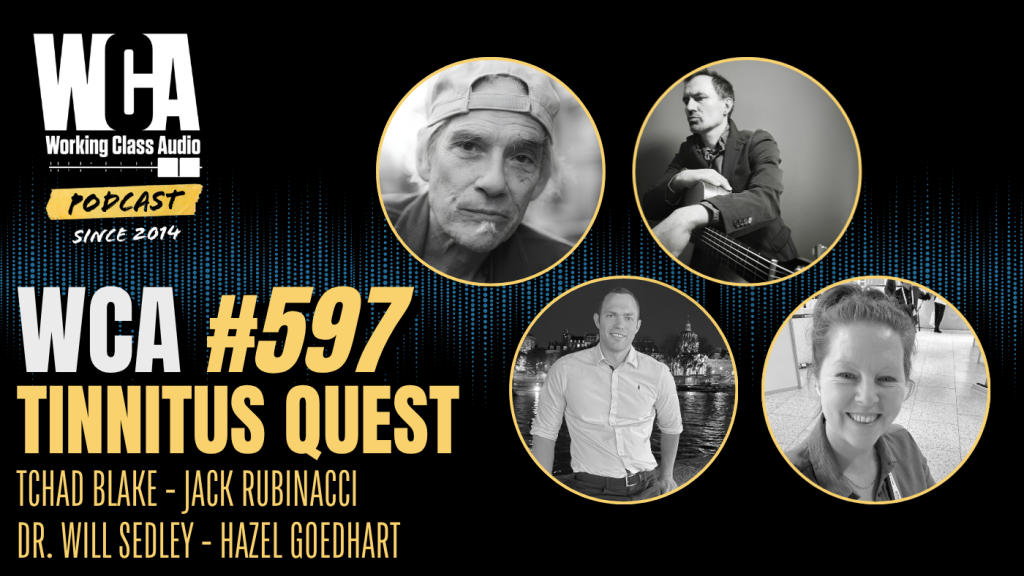
WCA #597 with Tchad Blake, Dr. Will Sedley, Jack Rubinacci & Hazel Goedhart – Tinnitus Quest
 Apple Podcasts
 Amazon Music
 YouTube
WCA #597 with Tchad Blake, Dr. Will Sedley, Jack Rubinacci & Hazel Goedhart – Tinnitus Quest: Breaking the Silence on the Music Industry’s Most Common Occupational Condition
In this episode of Working Class Audio, Matt welcomes a panel of four guests united by a common cause: Tinnitus Quest, a patient-driven nonprofit pushing to fund and accelerate tinnitus research. Tchad Blake — 7-time Grammy Award-winning producer, mixer, and engineer with credits including Paul Simon, Peter Gabriel, Paul McCartney, and Pearl Jam — opens up about living with tinnitus since age eight or nine, the result of childhood exposure to rifle fire, and how he has mixed some of the most acclaimed records of the past four decades with significant hearing loss in one ear. Neuroscientist and consultant neurologist Dr. Will Sedley of Newcastle University breaks down what the brain is actually doing when tinnitus occurs, from central gain theory to predictive coding, gating mechanisms, and why the brain’s compensation strategies can misfire. Hazel Goedhart, co-founder and Executive Board Member at Tinnitus Quest, shares her own tinnitus journey and how it led her to leave a career in financial services and fundraise her own salary to work for the cause full-time. And Jack Rubinacci, musician, songwriter, and Head of PR at Tinnitus Quest, explains how the organization is working to change the narrative around tinnitus the same way the mental health conversation shifted over the past generation — because that narrative shift is what unlocks funding, and funding is what drives research.
In This Episode, We Discuss:
- What Tinnitus Quest Is and Why It Was Founded
- The Scale of the Problem: 750 Million People, Almost No Research Funding
- Tchad’s Tinnitus Since Age Eight or Nine: Childhood Rifle Fire
- Mixing Iconic Records With Significant Hearing Loss
- Tinnitus as a Potential Creative Superpower
- How the Brain Compensates for Hearing Loss and Generates Phantom Sound
- Central Gain Theory and Neural Noise Amplification
- Synchrony: How Neurons Fire Together and Make Tinnitus Louder
- Gating Mechanisms and Why Some People’s Brains Filter Tinnitus Out
- The Predictive Coding Model: Why Tinnitus Embeds Itself in the Brain
- Hair Cell Damage vs. Synaptopathy: Two Different Types of Noise Trauma
- Recruitment: A Frequency-Specific Amplification Phenomenon
- Why Tinnitus and Hearing Loss Don’t Always Correlate
- Why Some People With Hearing Loss Never Get Tinnitus
- Sudden Sensorineural Hearing Loss: A Medical Emergency
- Tinnitus Spikes: What Causes Them and What the Evidence Says About Steroids
- Tinnitus as a Canary in the Coal Mine for Stress and Overexposure
- Fleeting Tinnitus: The Brief Episodes Most People Experience
- Low-Frequency Tinnitus and “The Hum”
- Musical Tinnitus and Musical Hallucinations
- Who to See: ENT vs. Audiologist vs. Neurologist
- CBT, Acceptance and Commitment Therapy, and Mindfulness for Tinnitus
- Tchad’s Personal Coping Strategies, Including Exposure Therapy and Harmonizing With the Ringing
- The Role of Psilocybin and Psychedelics in Potential Tinnitus Treatment
- Neural Plasticity, Synaptogenesis, and Why Psychedelics May Help
- Stem Cell and Cochlear Regeneration Research
- Is Tinnitus a Modern Problem? Pre- vs. Post-Industrial Noise Exposure
- The Stigma Around Tinnitus in the Music Industry
- How Bella Bathurst Connected Jack and Tchad
- TQ’s First Oxford Research Grant: Transcranial Ultrasound Stimulation
- Why Patient-Driven Funding Moves Faster Than Institutional Funding
- The Catch-22 of “Learn to Live With It” and How It Suppresses Research
Matt’s RANT!: Hearing Protection
Links and Show Notes:
- Tinnitus Quest
- WCA #334 with Jack Rubinacci
- WCA #200 with Tchad Blake
- Bella Bathurst – Sound: Stories of Hearing Lost and Found
- Newcastle University – Translational and Clinical Research Institute
Credits:
- Guests: Tchad Blake, Dr. Will Sedley, Jack Rubinacci, Hazel Goedhart
- Host/Engineer/Producer: Matt Boudreau
- WCA Theme Music: Cliff Truesdell
- The Voice: Chuck Smith
VIdeo Interview
Full Transcript (auto-generated)
Note: This is an unedited auto-generated transcript. Accuracy is not guaranteed, particularly for technical and medical terminology.
About Tinnitus Quest and the Founding Story
Jack Rubinacci: We’re here to talk about tinnitus, something that affects a lot of musicians, a lot of people in the music industry. Specifically to talk about trying to break down the barriers, trying to break down the stigma of it, and also to introduce Tinnitus Quest. Tinnitus Quest is a nonprofit and we’ve basically come together — we all have different backgrounds — and we’re trying to pull together our talents and create a nonprofit that can really push things forward because it’s really, really necessary.
To give you a visual metaphor, if you think of the annual global cost of tinnitus, it would be the size of an Olympic-sized swimming pool. The money that goes into research would be the size of a glass of water. And when you think that there are 750 million people plus affected by this, the numbers are just not adding up. So we’re trying to push research forward by changing the narrative, raising funds, and bringing together some of the best researchers in the world.
Hazel Goedhart: Tinnitus Quest was co-founded by a group of tinnitus patients, tinnitus sufferers. I’m one of those — that’s why and how I got into this. I developed tinnitus in 2017 and I was very, very distressed by it at first. I even couldn’t work for a couple of months. I did reasonably well habituate, as they say, which is a fancy way of saying you just kind of learn to live with it.
By now, I’m not really doing this for myself, although I would definitely still take the cure if and when it becomes available. I’m really doing it for others and because I’m fascinated by the science. I never thought I would actually be doing this full time, but since last year I ended up doing this full time. I fundraised my own salary so that I could work for Tinnitus Quest. We gave out our first research grant a few months ago. We’re just about to launch our second round of research funding where researchers can apply and submit new ideas for how to silence tinnitus.
Dr. Will Sedley: How He Came to Tinnitus Research
Will Sedley: I’m a medical graduate. I trained as a doctor and I moved up to Newcastle in 2007. I knew I wanted to do research — I was interested in the brain. There was a group doing research in auditory processing and after about a year, a colleague said, what about tinnitus? My first thought was, yeah, I know it’s a thing, a few people have it. It does not sound very interesting. But okay, I can’t think of anything better. Why not?
Only once I got into it did I realize how fascinating the mechanisms are, how much we still don’t know, and how much more we do know. To really understand tinnitus you’ve got to understand every level of the functioning of the brain and nervous system, right down from cells and synapses, up to whole networks and psychological frameworks. And I was startled to learn how incredibly common it is, and how many people are struggling.
Tchad Blake: Living and Working With Tinnitus Since Age Nine
Tchad Blake: I’ve had tinnitus since I was eight or nine. I was brought up in a family that had firearms. I was brought up shooting guns, and that was before anybody cared about giving anybody ear defenders, even on a proper shooting range. So this ear got the brunt of rifle fire. I’ve had pretty significant hearing loss on my left side all those years and just made it work being a recording engineer.
It wasn’t until my first seminar at Mix with the Masters — I think around 2009 — where two participants came up to me and said they loved what they were hearing but they would never be able to mix like the people there because they had tinnitus. I said, well, I have tinnitus and quite severe hearing loss on my left ear. If I were to show you my chart, you’d probably be horrified that I’m allowed to do what I do. That really got me thinking about it and talking about it at every seminar.
I’ve read about two types of damage — damage to the hair cells, and nerve damage, which is called synaptopathy. And recruitment is something I think is even more devastating than tinnitus alone, because it completely alters your hearing and what you perceive as your frequency response. It’s very frequency specific. The bandwidth can be quite narrow. That’s been my experience — it can shoot up 10 dB almost instantly.
Matt Boudreau: Has your mixing style, your recording style, all the audio decisions you make — is that based on compensation for the tinnitus and hearing loss?
Tchad Blake: Absolutely. Since the Mix with the Masters things and talking to people with tinnitus, I’ve come to think it might be my superpower. It’s shaped how I do things. If there’s an area where I get to a certain level that hurts a little, I’ll EQ that. Everybody has ears that have anomalies. There’s nobody that escapes the world of hearing anomalies, and that’s what makes people get creative in different ways.
The Science: How the Brain Generates Tinnitus
Will Sedley: In most cases there seems to be a degree of underlying hearing loss in tinnitus. Most frameworks frame tinnitus as something that happens in the act of the brain trying to compensate for hearing loss. The brain likes a sound input level of four. If you have hearing loss, that may go down to a two, and your brain is left with this conundrum. What am I going to do to get that back?
The first theories were central gain models — multiply it up. Every pathway in the brain, every cell does a bit of random firing. The hearing pathway is the same. Most people, even if they don’t think they have tinnitus, go into a totally silent room and pay very close attention — you will hear something resembling what we all know as ordinary common tinnitus.
Synchrony is probably quite key. If we think of the strength of the activity as how fast those cells are firing, synchrony is how much they consistently fire together. A bunch of neurons that fire at the same rate put together gets its message across much more strongly. It’s like a crowd of people chanting versus talking chaotically as a rabble.
Our brain also has gating mechanisms, controlled by higher parts of the frontal cortex and basal ganglia, that feed back to the thalamus. One thing that may play a role is failure or under-activity of these gating regions, meaning the signal makes it through to your auditory cortex as opposed to being amplified but still blocked out.
And then there is predictive coding. I often show people a famous picture with a load of black splodges on a white background. You look at it and realize it’s a Dalmatian dog sniffing under a tree. Once you’ve seen the dog and it pops out, you can’t ever look at that picture again and not see the dog. Something similar happens with tinnitus. Once your brain gets familiar enough with it, even if the strength of the noise in the pathway goes back down, your brain still recognizes the pattern. Forgetting it may be a harder job than not perceiving it to begin with.
Hazel Goedhart: One of the big unanswered questions in tinnitus science is why only some people develop tinnitus as a result of hearing loss. There are many people with hearing loss who don’t have any tinnitus at all.
Stigma and the Music Industry
Jack Rubinacci: One in five musicians in a Norwegian study had severe tinnitus. And probably more. If you think about where mental health is now — if someone says they need a timeout for their mental health, everybody understands. You tried that 20 or 30 years ago and the understanding would not have been as compassionate. We often talk about this in Tinnitus Quest: we have to move tinnitus forward the way that mental health has been pushed forward. That’s how we unlock funds and unlock research.
Will Sedley: I don’t think tinnitus in itself has to be a bad thing. It can be an indication that the brain is doing lots of important things to work around and best compensate for the conditions it’s facing. Tinnitus is the byproduct of doing what brains do well — doing the very best they can to keep their hearing and other performance as good as it can be in the conditions they’ve got.
Tchad Blake: For somebody to say to me that, now that they know I have hearing loss and tinnitus, they wouldn’t hire me — to have that fear is crazy, because I’ve had it since I was nine. So everything you’ve heard from my work has been going through, for the most part, what I’ve got. Maybe that’s given me a little bit of an edge. People thinking this is going to devastate their career — I have personal experience that it’s not.
Living With Tinnitus: Coping and Treatment
Hazel Goedhart: The doctors can’t do much for you typically. In most cases you very quickly learn — and we’ve heard thousands of stories of people saying the doctor basically told them there’s nothing he or she can do and to just learn to live with it. That’s what everyone gets to hear. There are no treatments that actually remove the tinnitus. That is what Tinnitus Quest is working on. It is very much needed that we find a cure, because not everyone just learns to live with it. We have spoken to people who are literally on the brink of suicide because of it.
Will Sedley: For people thinking about what they can do themselves — cognitive behavioral therapy and acceptance and commitment therapy are specific frameworks that can be helpful. For mindfulness approaches, the two components are: deliberately moving your attention between the various things in your body and outside that you can see, hear and feel. The other component is exploring with curiosity, with no judgment about whether you want the tinnitus to be there or not. It just is.
Tchad Blake: When I go to sleep and it’s a loud night, what I’ve been trying to do is harmonize with it in my head — try to have that be a drone and then make a little melody around it. Another thing: with things in life that are painful, I try to say, okay, this is here, it’s not what I want, but bring it on. Moving closer and staying longer, then retreating, then moving closer and staying longer. Exposure therapy.
Hazel Goedhart on sudden sensorineural hearing loss: Sudden sensorineural hearing loss is a medical emergency and people should immediately seek treatment if that happens. Steroids are the first line of treatment and you have a very short window of time — around 48 to 72 hours — for those to be effective.
Will Sedley on tinnitus loudness: There have been numerous studies done. The correlation between the loudness of tinnitus and the distress is so weak it’s almost zero. Things other than the loudness determine the distress. You can learn to live really well with the loudest tinnitus in the world. You can be driven mad by the quietest. And every combination in between.
The Oxford Research Grant: Transcranial Ultrasound Stimulation
Hazel Goedhart: We gave out our first research grant to the University of Oxford. The project tests non-invasive Transcranial Ultrasound Stimulation — a technique that has never been tried for tinnitus before. A transducer is placed against the side of the head — no surgery, no incisions. The question is whether ultrasound can reach deep brain targets that previous deep brain stimulation studies have shown to be promising for tinnitus reduction. The vision is a portable, wearable device — worn over the temples like headphones — delivering ultrasound once a month.
Emerging Research: Psychedelics, Neural Plasticity, and Stem Cells
Will Sedley: Psychedelics like psilocybin induce a lot of neural plasticity — the ability to make new and permanently altered connections. Plasticity in the wrong direction is said to be why tinnitus embeds itself in the brain. But if you can induce plasticity and do something that pulls you away from the tinnitus, you might be able to make it last. The psychedelics also stimulate synaptogenesis — they encourage new synapses to grow. There’s interest in psychedelics applied into the cochlea, not even the brain, showing promising results in animals for being able to regrow damaged connections.
Hazel Goedhart: Our board member, who is one of the most renowned tinnitus researchers and also a neurosurgeon, believes strongly that a combination of psychedelics with other therapies could work really well — because the psychedelics open up your brain to being receptive to the other therapy. Combining neuromodulation with psychedelics could work much better than using either alone.
Tinnitus as a Modern Problem
Jack Rubinacci: There’s evidence of the Egyptians having tinnitus — they called it the voice of God. But I would agree with the idea that maybe our ears are just not equipped for this sort of constant loud noise that we surround ourselves with, especially in cities.
Hazel Goedhart: I think it is a modern problem and unfortunately for the time being it’s going to get worse, with young people wearing earbuds at probably too high a volume.
Tchad Blake: What Hazel and Will have brought to this is I’ve learned an awful lot. I think this is invaluable. We can put it out there and have people see what we’re talking about. More people talking — that’s how we get more research, more money. That’s how we move forward.
Learn more: tinnitusquest.com